Winter on the Costa del Sol: what off-season life is really like
The question I hear most from friends back home: "But what do you do there in winter? Surely everything is closed." Well — it isn’t. In winter the coast simply carries on — more quietly, more cheaply and, honestly, more pleasantly.
Let’s start with the weather, since you’ll ask anyway
January on the Costa del Sol usually means 16–18 degrees by day and sunshine most of the month — the three-hundred-plus days of sun a year are not a marketing invention. It is not beach weather; the sea is mostly for Scandinavians and cold-water enthusiasts. But it is superb weather for everything else: breakfast on the terrace, cycling, golf, mountain trails behind the city. You wear a jacket in the evening. Scarves are worn mainly because they look good.
And here is the thing nobody back home believes me about: from the coast you can drive to a ski resort in the morning. Sierra Nevada is about two hours by car from Málaga — I know people who were on the slopes before noon in February and eating fish by the beach at three. They do it mostly for the photos they send home. I understand them completely.
One catch nobody mentions: Spanish flats were built for heat, not cold. Without heating, a January evening indoors can feel colder than outside. When buying, ask about air conditioning with a heating mode — it is not a luxury, it is three months of comfort a year.
Empty beaches are not sad — they are a luxury
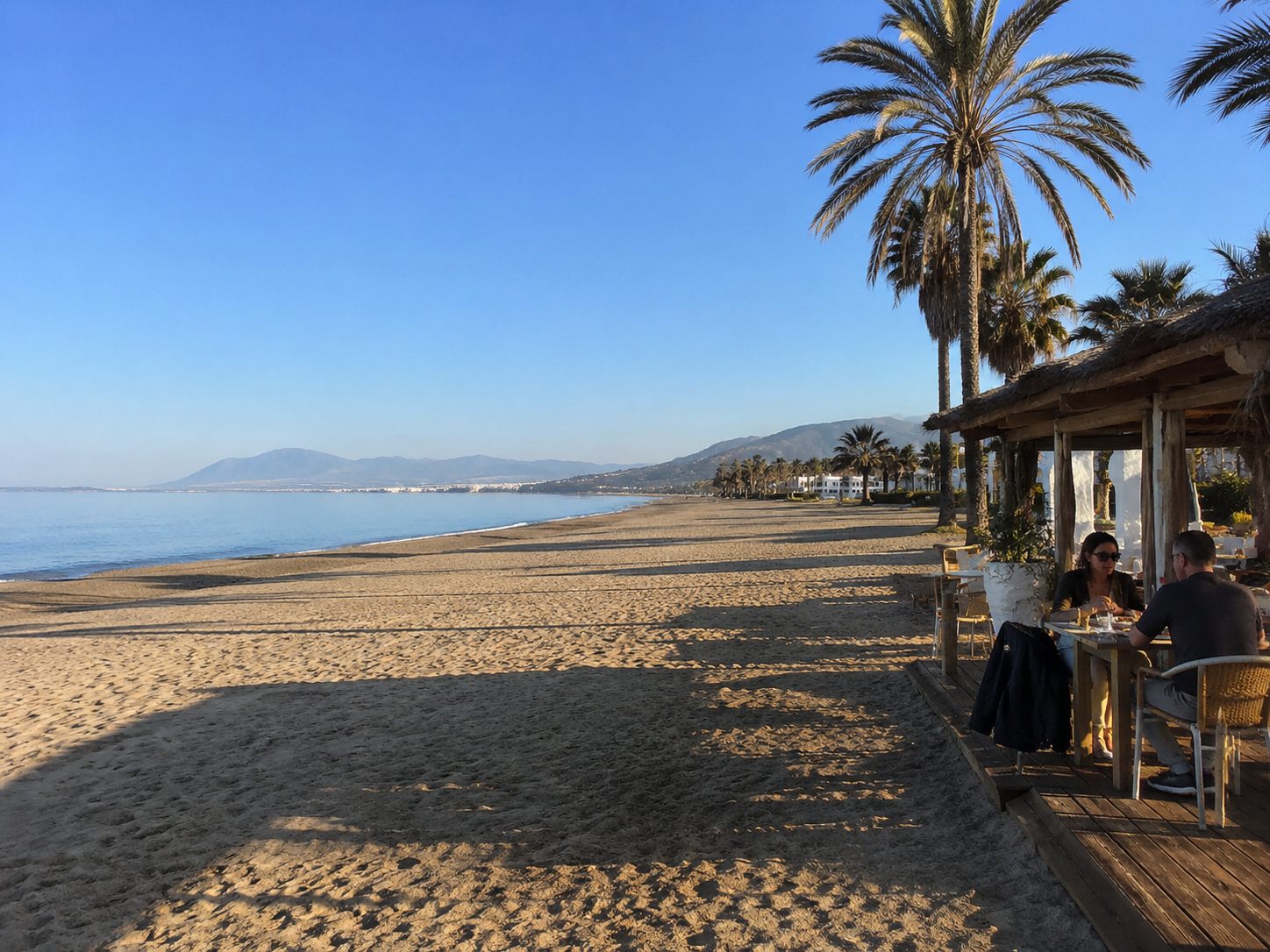
A November walk on a beach you share with two anglers and someone’s dog has something August can never give you. Chiringuitos in the bigger towns stay open all year — you take a table on the sand, order coffee and tostada with tomato, and watch a sea that no longer charges a seasonal markup. The paseo marítimo — the seafront promenade — is fully alive in winter: runners, cyclists, local pensioners in puffer jackets at eighteen degrees, and us northerners in T-shirts.
It is also the locals’ season. Restaurants suddenly speak Spanish instead of English, the waiter has time to chat, and the menú del día returns to prices that make cooking at home seem uneconomical.
Which towns live in winter — and which fall asleep
Let’s be honest here: the coast is not uniform. Málaga, Fuengirola, Marbella and Estepona hum all year round — they have residents, not just tourists. Smaller holiday developments, especially out of town, can look like an abandoned film set in winter: beautiful, empty, one café open.
We once had clients in love with a charming hillside urbanisation — they saw it in July and everything sparkled. I talked them into a second visit in December. They came back having decided on a flat three kilometres away, close to a town where the bakery, the market and three bars stay open in winter. To this day they call it the cheapest trip of their lives, because it saved them from an expensive mistake. If you plan to live here year-round, check what a town looks like in February before you fall in love with it in July.
Low season, low costs
In winter the coast is simply cheaper. Flights can cost as much as the taxi to the airport, car hire drops by half, and golf courses and restaurants offer deals unthinkable in summer. Owners of short-let apartments know the other side of that coin — winter occupancy falls — but more and more of them are discovering winter lets: remote workers and northern European retirees happily pay for three months of sun, and the flat no longer stands empty from October to March.
Winter is the social season, oddly enough
In summer everyone has visitors from home and a schedule like a hotel manager’s. In winter the coast slows down and suddenly there is time for a social life: padel leagues, walking clubs, Spanish lessons at the language school that finally has free places. The expat community here is large and well organised — from messenger groups to shared Christmas Eve dinners. I know people who feared loneliness in their first year and by the second winter had to learn how to decline invitations.
Who winter suits best
I know people who bought on the coast with holidays in mind and then rearranged their lives to spend winters here instead. Hard to blame them: they trade November grey for a place where morning sun floods the kitchen and lunch happens outdoors. Summer is for tourists. Winter is for those who know.