Here they celebrate all year round — the fiestas you can’t understand the coast without
You can live in Spain without speaking Spanish. You can fail to tell gazpacho from salmorejo. But you cannot live here and stay out of the fiestas — because the fiestas will come for you. They will close your street, reroute your bus and wake you at seven with firecrackers. And that is exactly as it should be.
Spring belongs to the processions
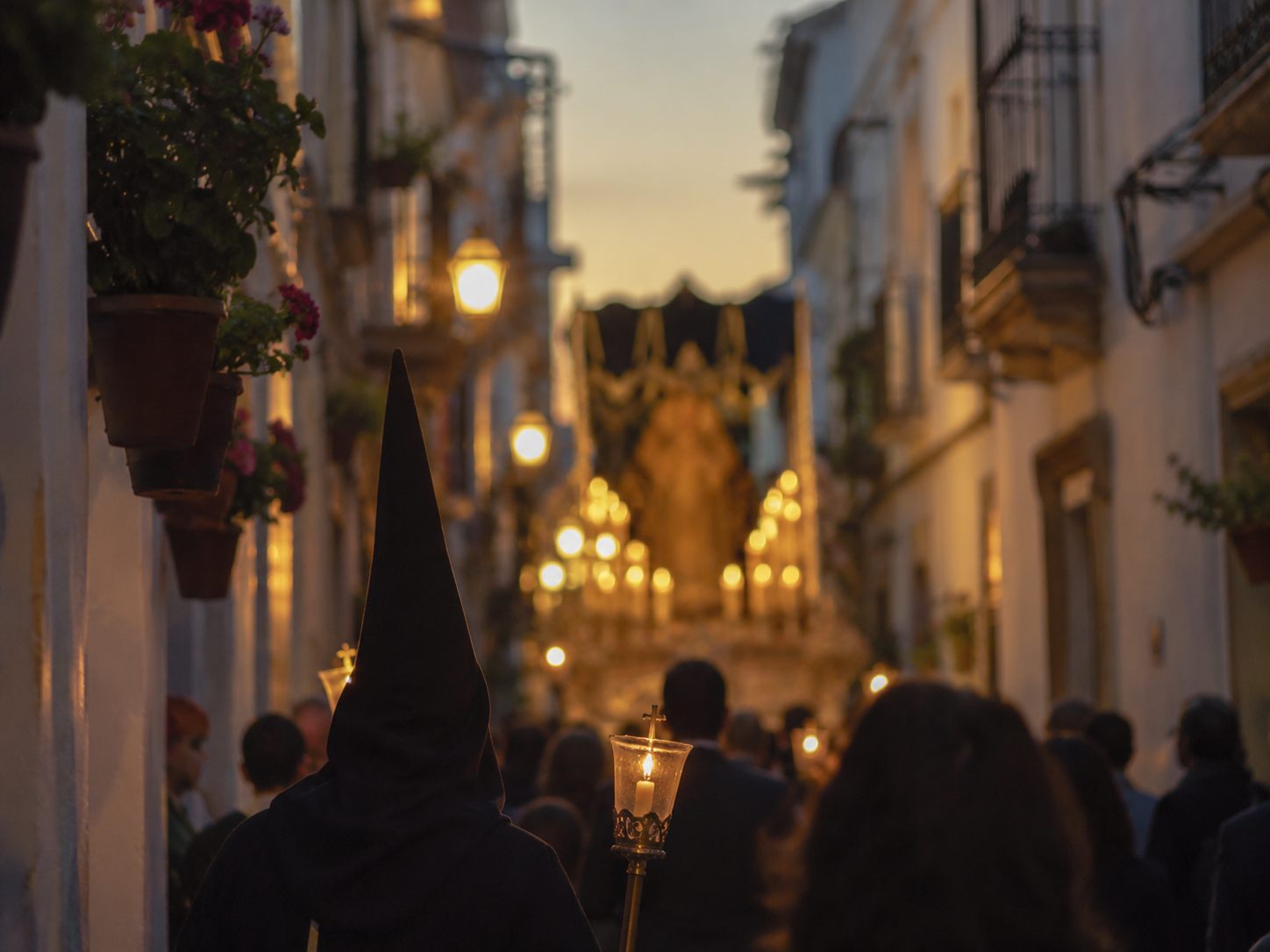
Semana Santa — Holy Week — is when Andalusia shows its most solemn face. For seven evenings the streets fill with processions: heavy thrones carried on the shoulders of dozens of men, wax and incense in the air, drums you feel in your chest. In Málaga it is spectacle on a scale no film director would dare — half the city lines the route, the other half carries the thrones. The most moving moment appears in no programme: someone on a balcony suddenly breaks into a saeta, a raw, unaccompanied song, and the whole crowd falls silent mid-word.
I spent my first Semana Santa with a procession map spread out, convinced everything could be planned. My neighbour, Málaga born and bred, looked at the map with pity and said: "Don’t plan. Step outside and let it carry you." She was right — the best things I saw were the ones I stumbled into. For a resident the week means one thing: you do not drive through the centre. Locals plan it like logisticians — they know which procession takes which street and when it will "fall". After two years, you do the same, without thinking.
May: crosses made of flowers and pilgrimages on carts
May in Andalusia is the month when it is hard to get anything done, because everyone is busy celebrating spring. Squares fill with Cruces de Mayo — crosses built from thousands of carnations, around which people eat, drink and dance sevillanas from morning to night. And on the following weekends the romerías set off: pilgrimages on decorated carts pulled by oxen and tractors, with guitars, baskets of food and whole families in traditional dress. A romería looks like a picnic that got out of hand — which is more or less what it has been for four hundred years.
June: the night the whole coast burns
San Juan night, June 23rd to 24th, is my favourite fiesta on the coast — because it happens on the beach. Families carry firewood, blankets and food onto the sand; at midnight the bonfires are lit, and then, as tradition demands, you walk into the sea to wash away the bad of the passing half-year. Miles of coastline dotted with fire looks like something from another century. They also burn "júas" — rag dolls standing for whatever you want rid of. I have seen an inflation doll and a boss doll.
Clients of ours picked up the keys to their Torremolinos flat on June 23rd of all days. They still say their first night in their own Spanish home was spent not unpacking boxes but at a bonfire with the new neighbours. Hard to imagine a better housewarming. By morning the beaches are spotless, as if nothing happened. Which is very Spanish: party until dawn, open the shop at nine.
August means feria
The Feria de Málaga officially lasts nine days; unofficially, two weeks. By day the celebration fills the centre: flamenco dresses, sherry from small glasses, street groups singing verdiales — old mountain music that moves your feet on its own. People pin a biznaga to their lapel: a little bouquet of jasmine on a thistle stem that you can smell from across the street. In the evening the city moves to vast fairgrounds full of casetas — tents where you eat, drink and dance until morning.
Every town on the coast has its own feria, smaller but often warmer: in Nerja, Estepona or Fuengirola you are simply celebrating with your neighbours. At a small-town feria nobody is a tourist — if you live there, you belong, and the neighbours will make sure your glass is never empty.
Autumn and winter don’t let up either
All Saints in November smells of roasted chestnuts — castañeros with cast-iron stoves appear on street corners, and a paper cone of hot chestnuts is the best five euros of the season. In December the cities turn into light installations; people travel from across Europe to see the illuminations on Calle Larios in Málaga, with light-and-music shows several times an evening. On New Year’s Eve, at midnight, the whole of Spain eats twelve grapes, one per chime — a simple task until you try it.
Then comes January 5th and the cavalcade of the Three Kings: here it is the Kings, not Santa, who bring children their presents, riding through town on floats and hurling sweets into the crowd. Kilograms of sweets. Bring an umbrella; I speak from experience — held upside down, it works as a basket.
What all this means when you live here
The fiestas set the calendar here the way seasons do elsewhere. You learn not to schedule a furniture delivery on Good Friday, that the town hall will reply after the feria, that on San Juan there is no point looking for a quiet beach. Worth knowing before you buy, too: a flat on a procession route or next to the fairground is a different life in April and August than in November. Some people love it, others tire of it — better to know which you are before you sign the deed.
In return you get something I missed most back home: a life that regularly steps out into the street and invites everyone in — including you. A friend of mine says that in Spain you don’t need to look for reasons to celebrate — you just need to stop resisting. After a few years on the coast, I sign that with both hands.