Character
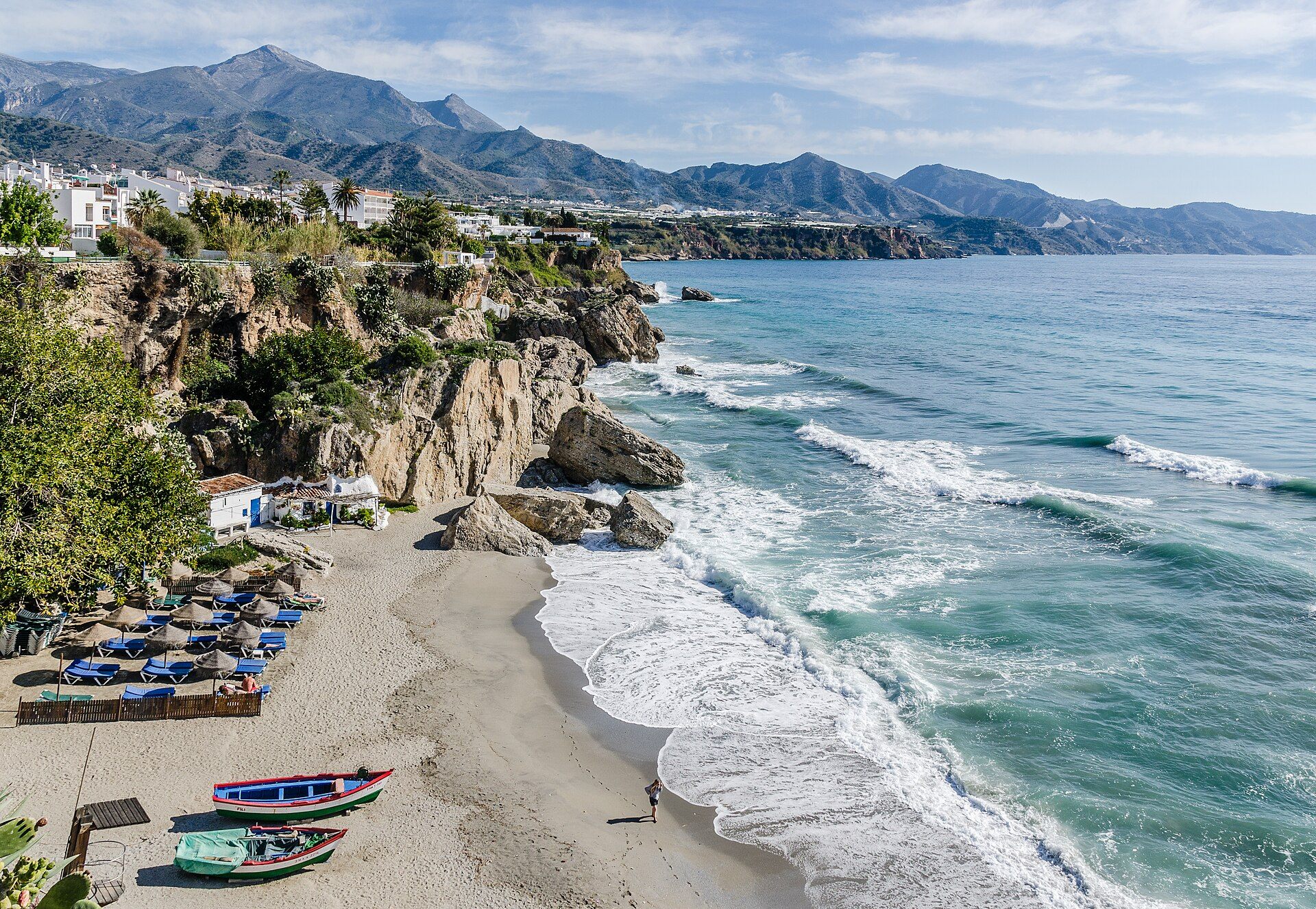
I walk every client through Nerja the same way: along the white lanes of the old town out onto the Balcony of Europe — a terrace above the sea with cliffs stretching both ways and the Sierra Almijara at your back. That moment usually settles it. Nerja is the last town of the Costa del Sol before the Granada border and one of the few that defended its scale: there are practically no tall blocks, and local rules keep it that way. Instead of a concrete wall there are coves between cliffs, stairways down to the beaches and architecture that still remembers being a fishing village.
Location and access
50 minutes east of Malaga airport on the A-7, which effectively ends just past town — beyond it there is only the winding old N-340 towards Granada. There is no commuter train and there won't be. It sounds like a flaw but works as a filter: Nerja stays calmer and less transient than the western coast. A car is useful day to day, though the town itself is walkable — end to end takes twenty minutes.
Everyday life
Everything within a stroll: the Tuesday market, small supermarkets, bakeries, dozens of restaurants — from chiringuitos on Burriana to genuinely ambitious Mediterranean kitchens. A large, settled British and Scandinavian community lives here, so English works everywhere, and the town does not hibernate — the cafés by the Balcony are full in January too. Bigger shopping, public offices and malls mean Vélez-Málaga or Malaga. That is the price of intimacy, and it is worth knowing before you buy.
Schools and healthcare
Public schools are local and well regarded; the nearest international school is in Almuñécar, twenty minutes away. There is a health centre in town, but the district hospital is in Vélez-Málaga — half an hour — with full hospital provision in Malaga. For families with young children that is usually enough; to clients planning a quiet retirement I say honestly that the hospital distance deserves a thought.
Leisure
The Nerja caves are a world-class attraction — underground halls so vast they host a summer music festival. The Rio Chillar trail runs for kilometres along the river bed, ankle-deep in water — in the heat there is no better plan. Then the beaches: broad Burriana with full services and the wilder coves at Maro, where you dive along the cliffs of the Maro-Cerro Gordo reserve. And ten minutes uphill lies Frigiliana, regularly voted Andalusia's most beautiful white village.
Who it suits
Nerja is for buyers after a second home with character, off the main tourist highway — for those who find Marbella too loud and Torrox too quiet. Just know that intimacy has a price: supply is small, new developments are few, and prices can run higher than the town's size suggests. In return, holiday rentals perform superbly — guests come back for years, and a sea-view apartment rarely stands empty between May and October.
Developments in Nerja
We currently have no open new-build development in this location — but we search on request. Tell us what you are looking for in Nerja and the surrounding area, and we will check availability directly with developers.
Looking for a property in Nerja?
We’ll search the full new-build database in this area and prepare a selection for your goal and budget — with no fees or commission.
Nearby towns
“Europe's best climate” — a village and Torrox Costa
A horseshoe bay, diving and calm
A subtropical climate without mass tourism
Editorial content — travel times and facilities are confirmed individually. Not advice.